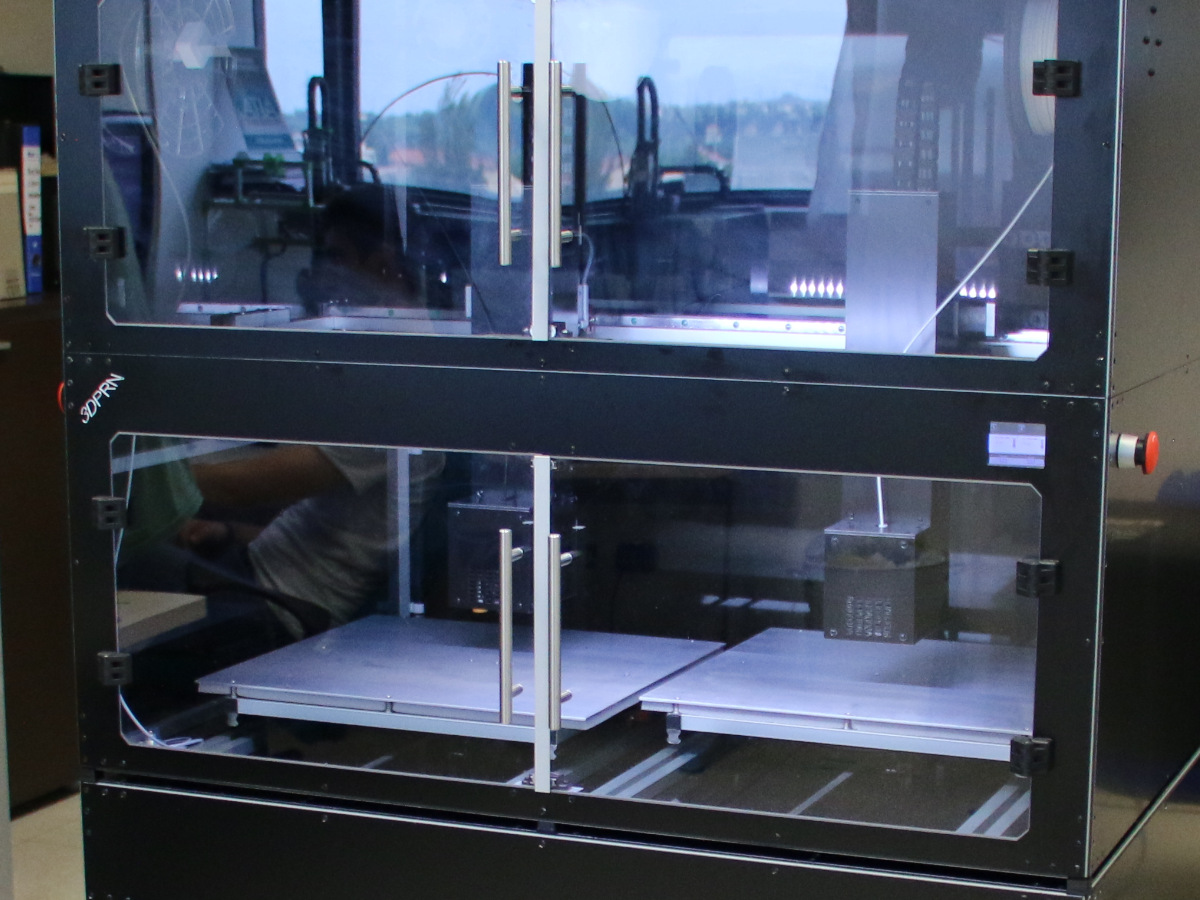
The large-format professional 3D printer offers some of the most interesting solutions for the services we want to innovate and for our product processes. The growth of additive manufacturing has opened up ever-increasing possibilities in the industrial sector, enabling the creation of prototypes, components, tools, molds, and small series with great programming freedom.
Unlike 3D printers designed for home or educational use, a large-format professional solution is designed to handle larger parts and meet the demands of a production environment. The goal is not only to produce large objects, but also to have technology capable of integrating into industrial processes where precision , repeatability, productivity, and flexibility are crucial.
For a company, investing in this type of technology can mean reducing development times, optimizing certain costs, and responding more quickly to customer needs.
What are the features of a professional large-format 3D printer?
A professional large-format 3D printer is primarily distinguished by having a significantly larger build volume than conventional solutions.
This feature allows the production of large parts that, with a smaller machine, would have to be divided into different parts for subsequent assembly.
The ability to produce a large component in a single operation can offer significant advantages. It reduces the number of joints between parts and, in certain applications, also reduces subsequent assembly and finishing operations.
However, the size of the print area isn’t the only factor to consider. For industrial applications, machine stability , handling system, process control, compatibility with different materials, and the ability to maintain consistent results during extended production runs are also important.
Professional large-format 3D printers: solutions for industrial production
A professional large-format 3D printer can have many applications within a company. The technology can be used both during the design and development phase and in certain stages of production.
Among the main applications we find:
- Large-scale industrial prototype production .
- Production of molds and models for various production processes.
- Production of customized equipment .
- Creating positioning models and devices.
- Production of functional components .
- Small series production.
- Production of custom pieces on request.
- Rapid development of new products.
- Production of spare parts.
- Production of auxiliary elements for machinery.
- Creation of models to check dimensions and assemblies.
- Development of specific solutions for industrial needs.
The ability to quickly move from digital design to physical object allows you to accelerate the various phases of the innovation process.
Rapid prototyping for industry
One of the main advantages of professional 3D printing is the ability to develop prototypes quickly .
With traditional methods, creating a prototype can require several steps and specific tools. Furthermore, any changes to the design can lead to additional costs and lead times.
Thanks to additive manufacturing, the process can be more flexible. The designer can modify the digital file and then generate a new version of the prototype.
This system promotes an iterative development process , allowing for testing and changes before going into final production.
For large parts, a large format printer also offers the ability to create complete models or large components without necessarily having to resort to numerous joints.
Production of tools and equipment
Another particularly interesting application concerns the production of tools, molds and industrial equipment .
Companies may need specialized devices to facilitate assembly, handling, or component placement. When these elements need to be customized, traditional manufacturing can prove inflexible.
3D printing allows you to create customized solutions for every need, directly starting from a CAD model.
Furthermore, if a modification is later necessary, the digital file can be updated and used to produce a new version.
This makes additive manufacturing a very useful tool for companies that need to continuously adapt their processes.
Small series production
Professional 3D printing can also be used to produce small batches of components .
Not all industrial products need to be manufactured in large quantities. In some industries, there are customized products, special components, or parts that are produced only when there’s specific demand.
In these situations, 3D printing can offer a flexible alternative.
The company can produce only the units needed, reducing the need to maintain large inventories. This approach can also be advantageous for some spare parts , especially when a quick response to a request is required.
Materials and industrial applications
The choice of material is a fundamental aspect for correctly using a professional large-format 3D printer .
Depending on the technology used, different materials can be used for technical and professional applications. Each material has specific characteristics related to mechanical resistance, flexibility, temperature, weight, dimensional stability, and finish .
For this reason, before starting a project it is important to analyze the conditions to which the work will be subjected.
A component intended for a visual prototype may require different characteristics than a component that will have to withstand mechanical stress or high temperatures.
The correct combination of printing technology, material and production parameters is essential to achieve an adequate result.
Reduction of production times
Speed is another important factor in the industrial environment.
Using a professional 3D printer allows you to reduce some of the time required to develop prototypes, tools, and components. Furthermore, the ability to produce directly from a digital file simplifies some phases of the process.
This can be especially important for companies that work with custom products or that need to quickly modify their solutions.
Increased development speed also allows errors to be identified at an early stage , before investing significant resources in final production.
Materials optimization
Another important aspect of additive manufacturing is the possibility of depositing material in a controlled manner, progressively building the piece.
In certain applications, this reduces waste associated with manufacturing processes where significant amounts of material are removed to achieve the final geometry. Optimization depends on the design, technology used, and manufacturing parameters, but it represents one of the aspects that make 3D printing attractive for certain industrial processes.
Furthermore, thanks to advanced design tools it is possible to develop optimized internal structures that allow to achieve a balance between weight, strength and material consumption .
The role of software in 3D production
An industrial solution isn’t just about the machine. Print preparation and management software also plays an important role.
Before producing a component, the 3D model must be transformed into the instructions the printer will use. During this phase, you can configure various parameters relating to resolution, speed, infill, supports, and other process characteristics. Proper preparation allows you to maximize the machine’s capabilities and achieve more consistent results.
For this reason, companies integrating 3D printing into their processes must consider both the hardware and the entire digital workflow .
3DPRN and professional 3D printing
In the field of professional and industrial 3D printing , 3DPRN offers solutions designed for companies that need to develop additive manufacturing projects with different levels of requirements.
The use of professional technologies allows us to tackle applications that require larger dimensions, materials suitable for technical uses, and greater control over the production process.
For companies, having a solution tailored to their needs can facilitate the gradual integration of additive manufacturing into their processes.
How to choose a large format solution?
Before purchasing a large-format professional 3D printer , it is advisable to carefully analyze your production needs.
The print volume is one of the first aspects to evaluate, but it is also necessary to consider the materials that will be used, the typical dimensions of the parts, the required precision and the expected number of operating hours.
It is also worth considering:
- Production volume .
- Maximum piece dimensions.
- Compatible materials.
- Level of accuracy.
- Printing speed.
- Ease of maintenance.
- Safety and stability during operation.
- Software available.
- Technical assistance.
- Possibility to adapt the machine to future needs.
The correct choice should be based on the actual needs of the company and not solely on the individual characteristics of the machine.
A technology for more flexible production
Large-scale additive manufacturing is expanding the possibilities of industrial production. Its ability to create large-scale components, prototypes, tools, and small production runs offers companies a flexible alternative to some traditional methods.
The true value of a large-format professional 3D printer lies in its ability to integrate into the production workflow and respond to specific needs.
Reduced development times, customization, on-demand manufacturing, and the ability to quickly modify designs are factors that can contribute to a more agile industry.
The professional large-format 3D printer: solutions for industrial production , represents an increasingly interesting option for companies wishing to modernize their processes.
From rapid prototyping to the production of tools, molds, components, and small series, this technology offers numerous possibilities.
The choice must be made taking into account the print volume, materials, precision, productivity and the specific needs of each application .
With proper planning, large-format 3D printing can become a strategic tool for developing products more quickly, optimizing certain processes, and increasing the flexibility of industrial production .